

In this exclusive VIP article only for The Baby Decision email newsletter readers, you’ll learn how to leverage a numeric scale to help you better see where you currently stand in your childfree vs. parenthood decision-making journey. This will lead to more understanding and less conflict within yourself—and with your partner, if you have one.
This is an exclusive preview from my forthcoming new book, due out in 2025. The new book’s working title is Baby or Childfree? Deciding in the Face of Climate Change, Fear of Missing Out, Regret, Pregnancy, Fair Role Sharing, and other Concerns.
By Merle Bombardieri, MSW, LICSW
Does your brain feel foggy and anxious when you try to work on the baby decision?
This may be because you have conflicting, positive and negative thoughts about both decisions swirling around in your head. Imagine a cat who’s chasing its tail so fast that its image blurs to the point where you can’t tell where the head begins and the tail ends.
To help you clear your head and relieve your anxiety, designed an 11-point decision making scale called The Baby Decision Scale™, which we’ll walk through together here. (I think you’ll find it enjoyable and enlightening!) I began using this scale over 10 years ago in my clinical practice, and I’m happy I can share it with you now. Please note, all material here is copyrighted.
.
About the scale
:
This scale is a continuum of reproductive decision-making—from absolute certainty about remaining childfree at one end, to absolute certainty that one must be a parent to be happy at the other. Most of my readers and clients step onto this scale somewhere between the extremes. However, they may have a partner who is a zero or a ten.
Please note, these numbers do not represent values placed on being childfree versus a parent. I simply chose zero for people who want zero children.
People at the 0-1 placement on the scale are certain they do not want to have a child. They may have known this since early childhood, which could have come from dislike of children, negative babysitting experiences, or from noticing how much their parents struggled with them and their siblings. Someone who circles the zero would typically choose divorce over having a child with a partner who insisted on parenthood.
At the other end of the continuum, people who are 9 -10 feel as if they were put on earth to have a child. Becoming a parent is such a high priority, that they would break up with someone who insisted on being childfree.
Not everyone who places themselves at a 5 feels the same way about it. People who place themselves at 5 may feel stuck and impatient to move in one direction or the other, and fervently hope this chapter will start that movement. They want that decision to happen as fast as possible. But other readers might find that the number provides some equanimity, boosting their confidence in potential happiness with either choice. This may help them decide whether to commit to a potential partner whose number is much higher or lower than theirs.
.
Try it yourself
:
Grab a piece of paper and a pen (or digitally if you prefer) and draw a horizontal line across the page. Put a zero on the far left of the line, and a 10 at the far right. We are going to use zero to depict a person who is 100% sure they want to be childfree, and 10 to depict a person who is 100% sure they want to have at least one child.
Try to choose quickly because your spontaneous response is the most likely to be accurate. When you deliberate, you’re likely to overthink or to choose a number that you wish were true because you don’t want to face the problems that might come with your best answer. For example if you know that you and your partner are several spaces apart on the scale, you may be tempted to pick a false number for yourself, to avoid conflict.
For example, Josh is a 9 but he knows that Jen is leaning childfree, and he doesn’t want to upset her. He wants to avoid “that conversation.” Emily is a 7.5 and Phil is an 8 but she doesn’t want to even think about pregnancy and childbirth. But the honest answers lead to the truth that you need to know and also lead productive conversations with your partner, decision coach or therapist, and others.
.
How the scale will help your decision-making
:
There are four significant ways the scale can bring you to the right decision:
1. It busts the assumption that you don’t have a clue, that your mind is a blur and that you will never make a decision. The scale forces you to identify your exact position now. That’s an accomplishment, a successful experiment in self-trust. Even if that number changes later, you are already on your way to finding the right one!
Once you see yourself at a specific number rather than a hopeless, endless blur, you can focus on making the decision rather than cursing your stuckness. If you know where you are on the scale it’s easier to decide where to go next.
When I asked Eliana (a composite of clients, not an actual person) she was surprised how quickly she answered “6.5” (yes, you can use decimals!) even though the number may change in an hour or a day, or even back and forth on the same day, a major shift occurs when you pick a number. You’ve taken the risk and responsibility to state your truth in this moment.
2. You can use a graph or table to track your progress over time.
On paper or digitally, every few days or weeks, if you choose a new number on an unmarked copy of the scale, you can track your progress. It also helps if you record events or insights that move the number. For example, Eliana’s table looked like this:
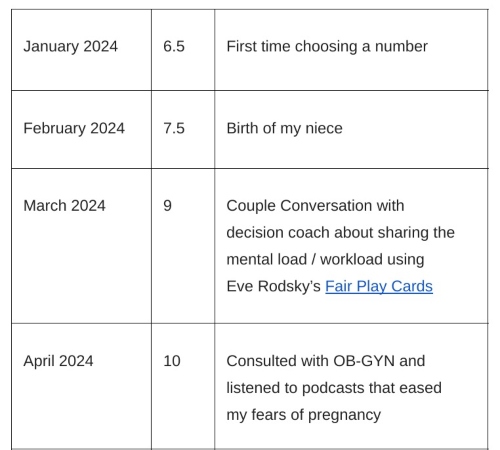
Even if your numbers skip around, plotting them can help you feel more in control and able to take actions such as doing exercises from my books, researching childfree living or parenting, and attending coaching or therapy sessions—individually or as a couple.
3. The scale leads to better conversations with your partner, if you have one.
Eliana’s partner, Jesse, marked his position at 7, and also guessed where Eliana was. As we learned above, Eliana chose 6.5 for herself. But Jesse guessed 9.5 for Eliana. And Eliana guessed 4 for Jesse.
This led to a surprising and productive conversation. Jesse thought Eliana had already chosen motherhood, but it wasn’t true. She had major reservations to work on (see the previous section) including fair sharing of potential tasks. Eliana thought Jesse was leaning more toward childfree than he actually was.
4. It makes conversations easier for couples who are on totally opposite ends.
For example, Christopher was a 3 and wanted to be childfree. Lara was an 8, longing for motherhood. Even though Christopher would have preferred to remain childfree, and certainly would have remained childfree had he had a partner who shared his preference, he was ambivalent and willing to work on that with Lara in hopes that they could stay together. He loved the freedom of hiking trips with and without Lara, as well as solitude. But he had a great childhood and felt wistful about not getting to be a father, especially since he knew it would please Lara.
They talked about how they would parent well together. Lara wanted to have two or three children. They worked it out that they would have just one child, and they would build in free time for both parents for individual pursuits. By choosing numbers, and clarifying each other’s positions, they made a decision to have a child.
This approach works equally well for any couple where one member is a zero and the other is a 6, leaning toward parenthood, yet attracted to the freedom, control, and introspection time of the childfree choice.
Although Alex and Amanda found the scale helpful, they didn’t need each other’s numbers to know they were at odds. But they found the love and courage to understand that Alex was a 10 and Amanda was a zero. They were concerned about each other’s wellbeing. No matter how much brainstorming they did, they could not imagine Amanda enjoying raising a child, nor Alex remaining childfree for Amanda’s sake. Even though they were devastated to give each other up, they had an amicable divorce. And within four years after their breakup, they found partners who shared their preferred choice.
Using the “Tug of War” chapter in The Baby Decision, I would suggest asking “What could I do to make my choice more attractive to you?” or “Tell me more about your vision of why you think our lives would be great with your choice.”
.
In sum
:
Whether or not you have a partner and whether you align or disagree on your baby decision feelings, looking at numbers outside of the extremes of zero and 10 may give you more hope of finding a solution. Rather than staying confused or frustrated, you can use The Baby Decision Scale as a springboard to a decision that works for you.
— Merle
Keep this conversation going!
…
What questions or uncertainties do you have that I might address? How can I help you make the right choice for you? Reach out to me via this website’s contact form, or in our private Facebook group The Decision Café, or on any of my social media pages: on Facebook, or Twitter/X, or on Instagram, where I often post other fun bonus content.
If a friend or colleague sent you this story and my free, bimonthly newsletter (also called The Baby Decision), please stay in touch and subscribe. Then you’ll be sure to get all of my event announcements, book previews and other VIP articles that aren’t posted anywhere else. You can quickly sign up for free here or in the pop up box below.
If you are new to The Baby Decision email newsletter and this website, you should know that you can find more helpful posts from me and other contributors on The Baby Decision blog and in future newsletter issues.
Thanks for following me and subscribing to my newsletter. Let’s chat soon!
– Merle Bombardieri
Photo on this page by Martin Baron on Unsplash.com